Almudaina Palace - Bellver Castle - Arabic Baths - Palma de Majorca Cathedral - San Francisco Church - Palma Townhall - Cartuja de Valldemossa - Palau March - Es Baluard - Pueblo Español - Auditorium
Quién
llega a Palma por el mar no puede menos que quedarse impresionado y
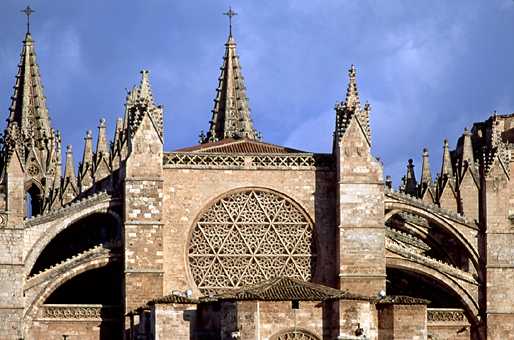
admirado de la gradual visión de las líneas góticas
de la Catedral que surgen erectas,
a medida que nos acercamos, por encima de las palmeras que hay delante, sobre las viejas casas de los viejos y
antiguos barrios y sobre las coloreadas barcas de los pescadores, hasta
verse reflejada en las tranquilas
aguas del puerto. La Seo, como se la llama aquí, fue constuida
sobre las ruinas de una anterior
mezquita árabe. Dice la leyenda que en una noche del 1229, Jaime
II, en el viaje hacia la conquista
de Mallorca, fue sorprendido por un terrible temporal y promentió
a la Virgen que, si se salvaba, mandaría construir una iglesia
en su honor.
Empezada en 1230, la Catedral pudo
considerarse terminada en el 1601.
Construida con los famosos sillares dorados de la piedra de Santany,
de estilo gótico francés,
tiene una longitud de 121 metros y una anchura de 55 metros: la nave central
de la iglesia está sostenida por una gran cantidad de
columnas delgadas a pináculo, y detrás de estos pináculos
hay gruesos contrafuertes unidos por una doble fila de arcos por tanquil.
El campanario con 52 metros de altura
y con tres pisos de arcos ojivales, no se ha terminado nunca: contiene
nueve campanas, una de ellas es la famosa campana de
N'Eloi, con un diámetro de casi 2 metros y pesa más de
5.700 kilos.
La fachada
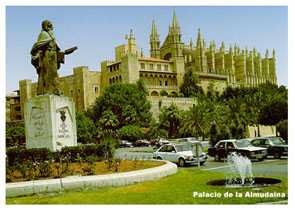
principal frente al Palacio de la Almudaina se cayó durante un fuerte terremoto en 1851 y fue completamente
reconstruida, menos el portal de estilo renacentista, obra de M. Verger,
que milagrosamente quedó intacto.
En la fachada que da al mar, otra puerta es una auténtica
obra de arte de la escultura gótica
española. Es la porta del Mirador o Puerta del Mar, en la cual
trabajaron numerosos y excelentes escultores, entre ellos Pedro de Moret (de él es la estatua de la Virgen
con el niño, cuyo original se halla en el Museo Diocesano) y
Juan de Valenciennes, que esculpió la Ultima Cena y la
Trinidad. El más importante de ellos es Guillermo Sagrera, cuyo
arte fino y delicado es visible sobre todo en las dos estatuas de San
Pedro y San Pablo que encuadran
el portal. El interior amplio luminoso nos impresiona por sus amplias
y armoniosas proporciones. Consta
de tres altas naves con columnas octogonales de 44 metros de altura,
con ocho capillas a ambos lados sin transepto ni deambulatorio.
Al fondo se halla la majestuosa capilla real, la cual tiene casi las
dimensiones de una iglesia: 25 metros
de largo y 16 metros de ancho. El altar mayor, consagrado el 1. de octubre
de 1346 está dominado por una enorme lámpara de hierro
forjado ideado por D. Antoni Gaudí
como si fuese un enorme baldaquín del altar. Detrás se hallan los 110 sillones de madera de nogal,
de precioso estilo gótico flamígero ya mano izquierda
un hermoso púlpito estilo renacimieto realizado por
J. de Salas. Al fondo de coro, un poco más elevada, se encuentra
la capilla de la S.S. Trinidad, antigua tribuna de los reyes de Mallorca y ahora panteón de dichos
reyes.
Any visitors approaching Palma by sea cannot help but be impressed, even astonished, by the graceful Gothic cathedral as it gradually emerges into view.
Its upward-reaching lines seem to rise endless as the boat gets nearer, until they merge into its protective shield of palm trees in front, the old quarter houses behind it, and the colorful fishing boats and their undulating reflection in the calm waters of the bay.
The Seo, as it is called here, was build on the site of a preexisting Arab mosque. One night in 1229, as Jaime I was on his way to recapture Majorca, his fleet was struck by a terrible storm. He vowed the and there to the Virgin Mary that if he survived nature´s fury, he would erect a church in her honor. And after the storm had blown over, finding himself safe and sound, he immediately undertook the project. It was a vow that was to take an inordinate amount of time to fulfill. begun in 1230, the cathedral was finished in 1601.
The rear interior reveals the majestic "Royal Chapel", which is nearly as large as a church in its own right: 25 meter long and 16 meter wide. The main altar, consecrated on October 1, 1346, is surmounted by one enormous "wrought-iron chandelier", forged by Antoni Gaudi as if it were the baldaquin for the altar.
Behind it, we see 110 breathtaking walnut choir-stalls sculpted in flaming Gothic style and, to left, a noteworthy "Renaissance pulpit" by J. de Salas. On a slightly higher level at the back of the choir-stalls, the "Chapel of the Holy Trinity" reveals the ancient tribune of the kings of Majorca and a sort of present-day pantheon for the same: in fact, it houses the sepulcher containing the mummified body of Jaime II and a 1948 Gothic-style tomb by Federico Marés with the ashes of Jaime III, the last in the line of the short-lived but glorious Majorcan dynasty.
.
The "Treasury" is another "must" of the cathedral. It is located in two capitular rooms dominated by a monumental churrigueresque-style door. The first room, by Guillermo Sagrera, is Gothic, while the second is baroque. Its inventory of priceless items includes an enormous gold-plated silver monstrance, which is elaborately etched in Gothic style, and two large baroque candelabras made of silver and weighing 250 kilo each. They were made at the beginning of the 18th century by silversmith Juan Matons of Barcelona on commission from a certain Juan Roig.
Their historic and artistic value is truly beyond calculation.
Pictures from La Seu - Palma de Mallorca.
A well-preserved temple ordered by king Jaume I in 1229 when he arrived to re-conquer Majorca.